
Guardsman Air Duct Cleaning in South Ozone Park: A Homeowner’s Guide
Guardsman products sold at big-box stores handle surface dust and odors in a duct you can reach. They cannot reach 20 feet into a flex duct trunk line, and that’s exactly where South Ozone Park’s older housing stock collects the most debris. Most homeowners who buy a retail kit aren’t wasting money on nothing – they’re just buying the wrong tool for what’s actually happening inside their walls. If you’d rather not gamble on a spray can, call (833) 637-5806. We answer 24/7.
Key Takeaways
- Guardsman retail products treat surfaces and odors; professional systems agitate and extract debris from the full duct interior.
- South Ozone Park’s post-war row houses and 1970s-1990s construction each produce different contamination patterns.
- Surface coating without mechanical cleaning can trap debris rather than remove it.
- Ask any contractor which EPA-registered products they’re using and how they verify application.
What Do Guardsman Air Duct Products Actually Do?
Guardsman products are surface treatments and protection plans. They coat, they deodorize, they leave a protective film. What they don’t do is remove the loose debris, dust buildup, and settled particulate sitting on the interior walls of your ductwork. That distinction matters more than most homeowners realize.
Think about what’s inside a typical South Ozone Park duct system. Air moves through at variable pressure, dropping heavier particles at every turn, joint, and transition. Over years, a fine layer builds up along the bottom of horizontal runs and collects at elbows. Aerosol products mist that layer. They may mask the smell. They don’t lift it off the metal or flex liner, and they certainly don’t pull it out of the system.
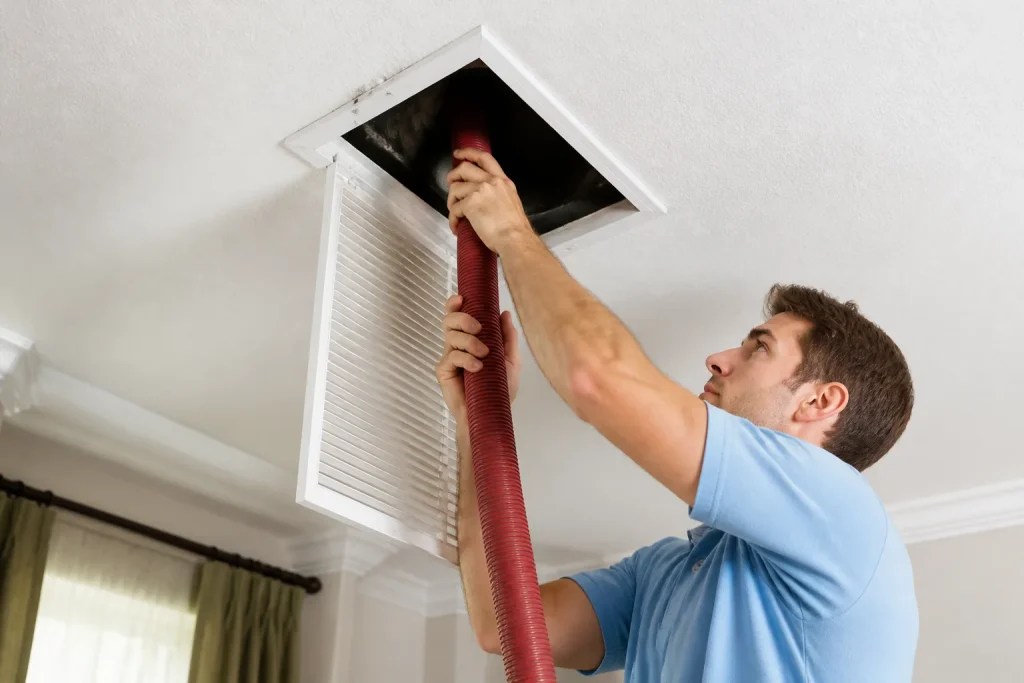
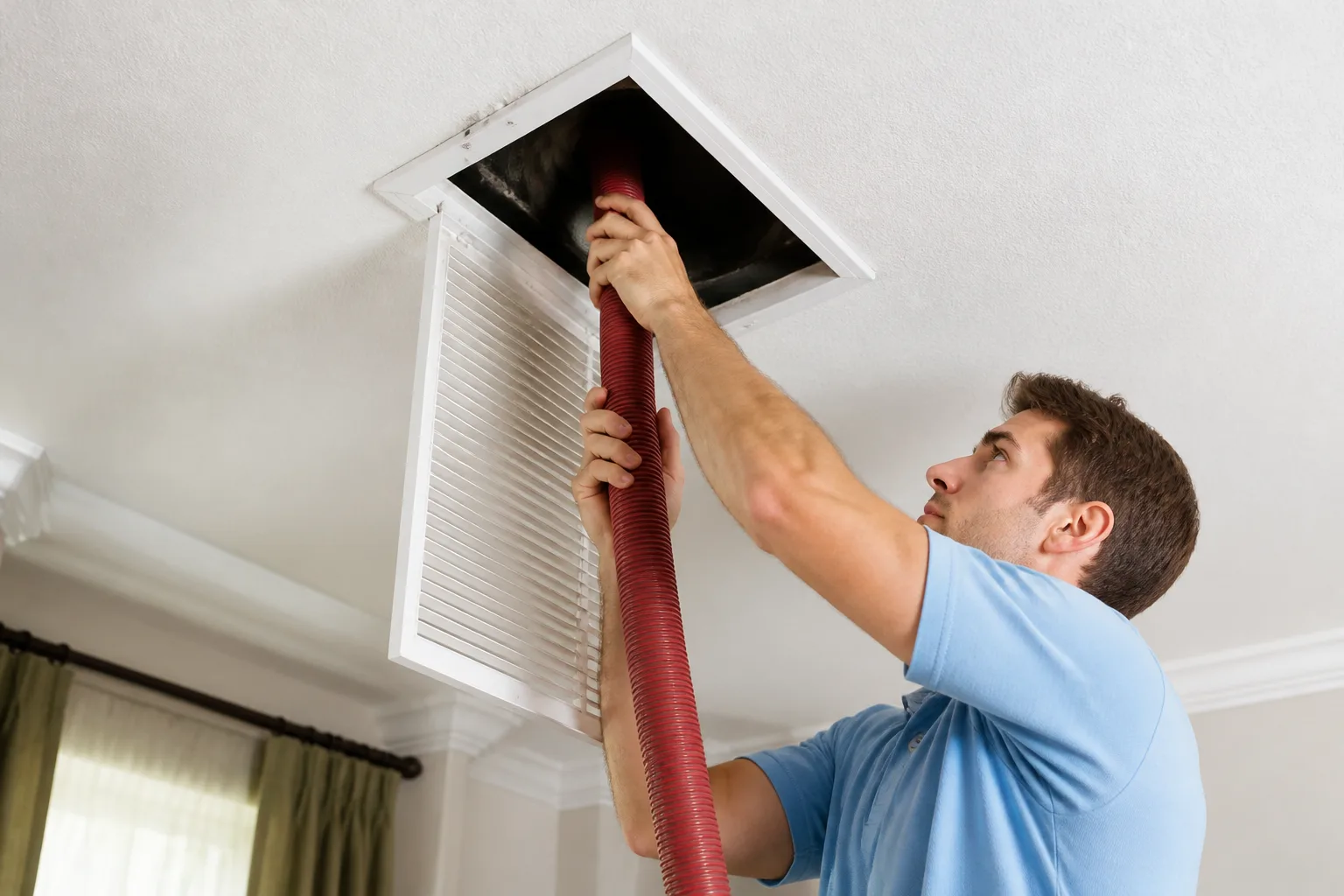
Professional cleaning works differently. With a Rotobrush rotary brush system, a flexible whip with rotating bristles travels the length of the duct, mechanically agitating the debris off the walls. A Nikro negative-pressure unit attached at the other end pulls everything dislodged into a HEPA-filtered containment. The debris leaves the system entirely. That’s the difference between treating a surface and cleaning a duct.
For South Ozone Park homeowners, this is the first thing to understand: retail products aren’t useless, they just operate on a different scale. Guardsman products work fine in a short, accessible run. They’re simply outmatched by what a 20-foot trunk line holds.
Why South Ozone Park Housing Creates Specific Duct Contamination Profiles
South Ozone Park’s housing stock tells a story about duct contamination that no retail treatment can read. The neighborhood is a mix of post-war row houses – tightly built, often with original or partially updated ductwork – and homes built from the 1970s through the 1990s where duct materials and configurations changed substantially.
Here’s what those two periods mean in practice:
- Post-war row houses: Dense construction, shared walls, sometimes retrofit ductwork that was squeezed into spaces never designed for it. Long horizontal runs with multiple transitions. Debris tends to accumulate at the low points and transitions.
- 1970s-1990s construction: More flex duct used in attic and crawlspace runs. Flex duct has ridges and corrugations that trap debris in ways smooth metal doesn’t. Particles settle into every fold.
Add seasonal humidity swings and the ordinary dust load of a neighborhood with mature street trees, and the accumulation profile is predictable. The bottom of a horizontal run in a South Ozone Park home can hold a decade of settled particulate before anyone notices a symptom.
Retail treatments can’t survey that. They can’t see which runs are worst. Professional cleaning starts with an assessment – what kind of duct, where it runs, what’s accumulating where – before a single brush goes in. Clean ducts start at the problem, not the surface.
Surface Coating vs. Mechanical Agitation: Why the Distinction Matters
Surface coating is exactly what the name suggests. A product is sprayed onto the interior wall of the duct. It bonds to what’s there, including the debris. Mechanical agitation is different: a rotating brush physically scrubs the duct wall, loosening the adhered layer so negative pressure can evacuate it.
Why does this matter for air quality? Because coated debris is still debris. It’s still sitting inside the air pathway. Every time the system cycles, air moves past it. Some particles lift. The coating may have sealed in odors temporarily, but it hasn’t changed what your HVAC is breathing through.
Mechanical agitation followed by extraction actually changes the interior condition of the duct. When we deploy Rotobrush and Nikro equipment, the sequence is deliberate: agitate every surface, capture every dislodged particle, verify the system is clean before closing it up. Then, if a homeowner wants additional sanitizing, the surface is genuinely clean beneath the treatment.
If you’ve had a previous surface treatment and want a real assessment of what’s still in the ducts, Air Duct Cleaning South Ozone Park covers how the process works and what to expect. Our technicians have up to 9 years of experience reading exactly these situations.
How Do You Audit Whether a Previous Guardsman Treatment Left Residue?
If a previous treatment was applied to your ducts – whether a Guardsman product or a similar retail coating – the question becomes whether it’s still there and what it’s holding. Residue from a coating that bonded to dust rather than clean metal can create a gummy layer that traps new debris faster.
Here’s how a proper audit works:
- Visual inspection of accessible runs. A technician opens supply and return registers and uses a camera to look inside. Coating residue shows as a uniform film, patchy overspray, or stuck-together dust clumps.
- Surface feel test in accessible sections. A gloved hand on the duct interior tells the technician whether the surface is dry, tacky, or gummy. Tacky surfaces indicate a coating that never fully cured and is now collecting debris.
- Airflow measurement. Restricted airflow at registers can point to coating buildup at transitions or a partially blocked run.
- Assessment of whether sanitizing is safe to apply. Applying any sanitizer over an unremoved coated layer just seals the problem in. The residue needs remediation first.
Guardsman and Abatement Technologies products used professionally are applied only after this sequence is complete. Our air quality and sanitizing work uses products from Guardsman and Abatement Technologies on surfaces that have been mechanically cleaned and verified – never over residue.
If you’re not sure what a prior treatment left behind, that’s exactly the situation a professional inspection answers. Products from Honeywell and Aprilaire for ongoing air quality work also depend on a duct system that’s genuinely clean first.
What to Ask Any Contractor Who Mentions Guardsman-Affiliated Coatings
Not every contractor who names a brand uses it correctly. Some spray a retail-grade product and call it professional service. Here’s a short list of questions that separate a real duct cleaning operation from a treatment service wearing a professional label.
- Which EPA-registered products are you using, and can you show the label? EPA registration is verifiable. Ask for it in writing.
- How do you apply the product? Fogging a whole system in one pass is not a professional application. It requires a clean surface, controlled application, and proper ventilation afterward.
- Do you mechanically clean the ducts before applying anything? If the answer is no, the coating is going over debris. Laminar
- What negative-pressure equipment do you use? A real operation will name their equipment – Nikro, Rotobrush, Abatement Technologies. “We have a vacuum” isn’t enough.
- Will you show before-and-after photos of my actual ducts? A contractor who’s done the work can show it. A contractor who sprayed a surface treatment usually can’t.
- What does your written estimate cover? One flat price per system, agreed before work starts. Not a per-vent figure that grows once the technician is in the door.
In South Ozone Park, we’ve seen enough professionally-labeled treatments that were really retail products in a different bottle. The audit questions above catch almost all of them.
When It’s Time to Call a Pro Instead of Treating It Yourself
The line between a DIY-appropriate duct and one that needs professional service is clearer than most homeowners think. If you can reach the duct with your arm and see the interior of the whole run, a surface treatment can make sense as a stopgap. If the duct disappears into a wall, a ceiling, or a trunk line, it’s out of reach.
Call when any of these apply:
- You notice dust puffing out of supply registers when the system starts.
- Members of the household have allergy or respiratory symptoms that improve when they’re away from home.
- Everyday smells linger longer than they should after cooking or cleaning.
- You’ve had a previous treatment and the problem came back within a season.
- Your dryer vent is overdue for dryer vent cleaning – a dedicated service for us, and a fire risk when neglected.
- You want a full assessment of the air pathway, not just one section. Full-spectrum HVAC cleaning covers ducts, vents, dryer exhaust lines, and system components together.
Professional cleaning also gives you a real baseline. Once ducts are genuinely cleaned, ongoing air quality work using Honeywell and Aprilaire solutions actually performs as intended. Duct repair and sealing fixes leaks and damage at the source instead of cleaning around them. Cleaning, sealing, and sanitizing together address the whole system rather than one segment of it.
Related services in South Ozone Park: proper air duct cleaning handles the main pathway; dryer vent and HVAC cleaning handle the rest. Each of these solves a different part of the same problem.
The Bottom Line
Guardsman products work in their lane. That lane is surface-level and short-reach. South Ozone Park’s mix of post-war row houses and 1970s-1990s builds creates duct contamination that sits deep in the trunk lines, trapped in flex corrugations, and settled at every transition. A retail kit doesn’t reach it. A professional negative-pressure system with mechanical agitation does.
The real questions worth asking are simpler than they sound: what kind of duct do you have, what’s accumulated inside it, and what was applied last time? Answer those and the right service follows.
If you’re in South Ozone Park and need help, Air Duct Cleaning South Ozone Park offers free estimates – call (833) 637-5806. We answer 24/7. Fast dispatch from 7am to 7pm, Sunday through Friday. The estimate is free, the price is set per job by the written estimate, and the technician is licensed and insured as the state requires.
Frequently Asked Questions
A typical whole-system cleaning in South Ozone Park is priced per system, not per vent, and the exact figure depends on the size and layout of your ductwork. You’ll get one flat price in a written estimate before any work starts. Call (833) 637-5806 for an exact quote – estimates are free.
Guardsman retail products treat surfaces and odors in the duct sections you can reach, which makes them a reasonable stopgap for short, accessible runs. They can’t reach deep into trunk lines or flex duct corrugations where the bulk of the debris actually settles. For anything beyond the first few feet, professional extraction does a job the aerosol can’t.
Cheap quotes usually mean per-vent pricing with a low teaser number, a shop vacuum instead of professional negative-pressure equipment, or a surface spray standing in for real cleaning. We work on one flat price per system agreed before work starts, and we show before-and-after photos of your actual ducts. Call (833) 637-5806 for an honest range.
Ask for before-and-after photos of your own ducts and an inspection of the accessible runs. A contractor using professional equipment – Nikro, Rotobrush, Abatement Technologies – can demonstrate what was removed. A surface-treatment service usually can’t.
Most homes in South Ozone Park benefit from a cleaning every three to five years, more often if you have pets, recent renovations, or allergy concerns. If symptoms or dust return within a season of treatment, that’s a sign of a bigger issue in the duct system itself rather than a cleaning schedule problem.
Written by the team at Air Duct Cleaning South Ozone Park.
Need Air Duct Cleaning Help?
Call Air Duct Cleaning South Ozone Park - the local pro we connect you with is licensed and insured, here with fast help in South Ozone Park.
(833) 637-5806